Web
Lexi Legal AI: Making Ethiopian Employment Contracts Less Scary
A behind-the-scenes look at Lexi Legal AI, a bilingual Ethiopian employment-contract reviewer that turns confusing clauses into citation-grounded risk reports.
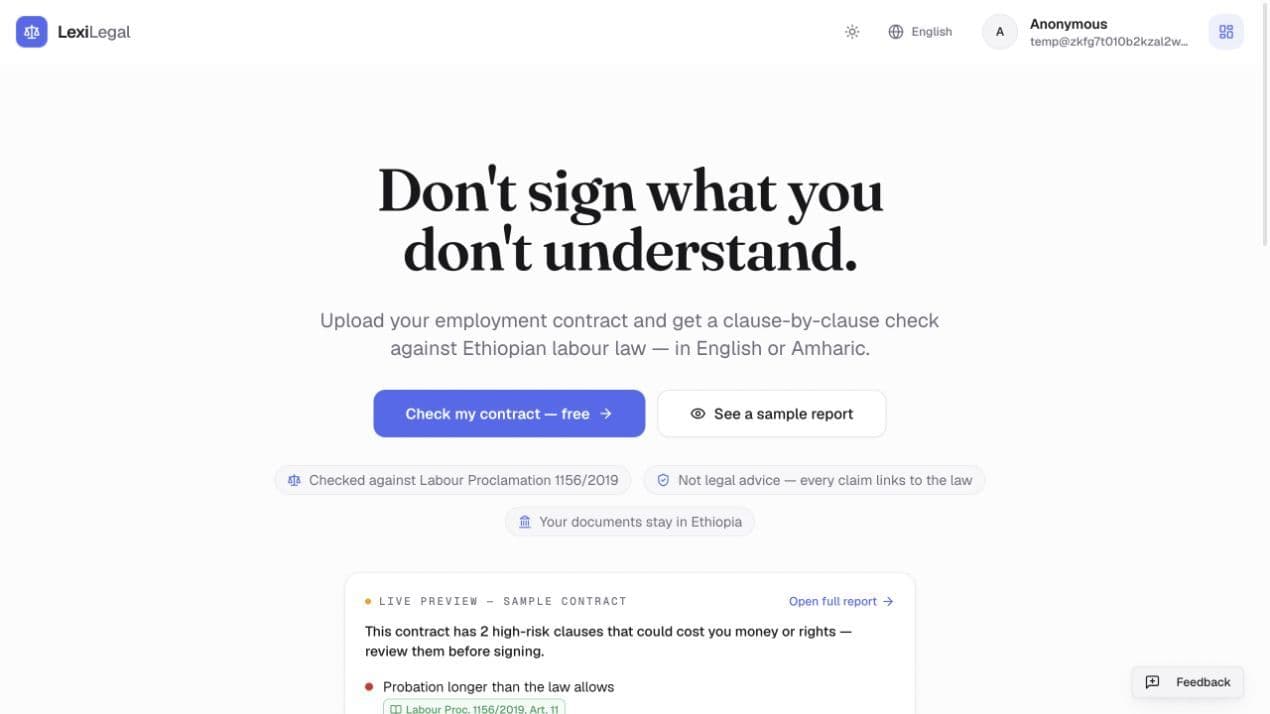
Signing an employment contract should not feel like defusing a tiny legal bomb with a PDF reader. Lexi Legal AI is built for the moment when someone gets a new job offer, opens the contract, sees ten dense clauses, and thinks: “Is this normal, or am I about to agree to something wild?”
The product is simple on the surface: upload an Ethiopian employment contract in English or Amharic, get a readable review, see which clauses look risky, and trace every serious claim back to legal evidence. Under the hood, it is a full-stack AI engineering project built around retrieval, citations, and a healthy fear of hallucinated legal answers.
Why Ethiopia makes this problem interesting
Ethiopian law gives this project a real civic angle, not just a shiny AI demo. The FDRE Constitution recognizes access to justice in Article 37, and Article 42 recognizes core labour rights such as association, rest, leave, public-holiday remuneration, equal pay for equal work, and safe working conditions. That matters because most people meet the law first through everyday documents, not courtrooms.
Employment contracts also have to be clear. Ethiopia’s Labour Proclamation No. 1156/2019 says an employment contract should leave the parties with no uncertainty about their rights and obligations, and should specify essentials such as the type and place of work, wages, payment method, payment interval, and contract duration. Lexi turns that idea into a product question: can a worker quickly see whether the contract actually tells them the important stuff?
There is also a modern privacy angle. Ethiopia’s Personal Data Protection Proclamation No. 1321/2024 raises the bar for systems that process personal data. A contract can contain names, salaries, addresses, ID details, signatures, and employer information, so Lexi has to be designed like a serious legal-data product, not a casual chatbot wrapper.
What Lexi does for users
Lexi is not trying to replace a lawyer. It is trying to make the first read less intimidating and more useful. Think of it as a contract-reading co-pilot that helps users walk into a conversation with better questions.
- It highlights high-risk, medium-risk, and acceptable clauses so users know where to slow down.
- It explains legal language in plain English and supports Amharic-facing workflows for local accessibility.
- It shows citation-grounded evidence instead of asking users to trust a black-box AI answer.
- It marks weak or missing evidence as insufficient instead of pretending every answer is certain.
- It helps users ask practical follow-up questions before signing, renegotiating, or seeking professional legal advice.
The fun part: a legal report that behaves like a product
A good legal-tech interface should not feel like homework. Lexi gives the user a dashboard-style report: risk chips, clause summaries, evidence cards, and clear next steps. The point is to make the scary parts visible without making the whole experience heavier.
The sample flow is intentionally direct. Upload the document, pick or auto-detect the contract language, run the review, then inspect the findings. Instead of one giant answer, Lexi breaks the contract into pieces. That makes it easier to spot patterns: vague termination wording, unclear payment timing, missing work location, overbroad confidentiality language, or clauses that deserve a second opinion.
The AI stack behind it
Lexi is a full-stack AI system, not a prompt pasted behind a form. The frontend is React, Vite, TypeScript, Tailwind, Radix UI, TanStack Query, react-pdf, and a focused document-review UI. The public app handles upload, sample reports, risk findings, and the interactive review experience.
The backend uses Node.js and Express for auth, document metadata, billing-ready product surfaces, API orchestration, and the bridge between the app and the AI service. MongoDB stores user and document metadata, while MinIO handles S3-compatible file storage.
The AI service uses FastAPI, Postgres, pgvector, OpenAI embeddings, and a retrieval pipeline tuned for legal evidence. The system chunks the legal corpus, embeds provisions, retrieves relevant passages, and asks the model to ground contract findings in those retrieved sources. Redis and a Python worker queue handle longer-running ingestion and analysis jobs, while Docker and Traefik keep the deployment reproducible.
The part I care about most: citation discipline
Legal AI gets dangerous when it sounds confident without showing its work. Lexi is built around a stricter rule: claims need retrieved legal support, and unsupported claims should be labeled as insufficient legal evidence. That constraint makes the product more honest and more useful.
- Hybrid retrieval searches the curated legal corpus before analysis.
- pgvector stores embeddings for semantic search over legal provisions.
- Risk scoring maps contract clauses to practical severity levels.
- Evaluation scripts check citation integrity so the system can be improved like software, not vibes.
Why this belongs in an AI engineering portfolio
Lexi shows the kind of AI work that matters beyond a demo: product thinking, domain constraints, retrieval quality, data privacy, bilingual UX, async processing, observability, and a deployment architecture that can grow. It connects full-stack engineering with AI engineering in the place where users actually feel the difference: a real document, a real risk, and a clearer next step.
The best version of legal AI is not the loudest answer. It is the one that helps a person understand what they are signing, shows where the answer came from, and admits when the evidence is not strong enough. That is the product philosophy behind Lexi Legal AI.
Try it
Live app: lexi.yared.site. Code: github.com/yaredtekile/lexi-legal-ai.
Sources
FDRE Constitution - Articles 37 and 42 on access to justice and labour rights.
Labour Proclamation No. 1156/2019 - employment-contract clarity and core worker/employer obligations.
Personal Data Protection Proclamation No. 1321/2024 - Ethiopia’s current personal-data protection framework.
Important note: Lexi Legal AI provides information and document review support. It is not legal advice and does not replace a licensed Ethiopian legal professional.