Web
AtomicForge: Building a Habit App Around Atomic Habits
A product tour of AtomicForge, a calm habit-building app shaped by James Clear’s Atomic Habits: identity votes, the 4 Laws, two-minute starts, forgiving streaks, and visible progress.
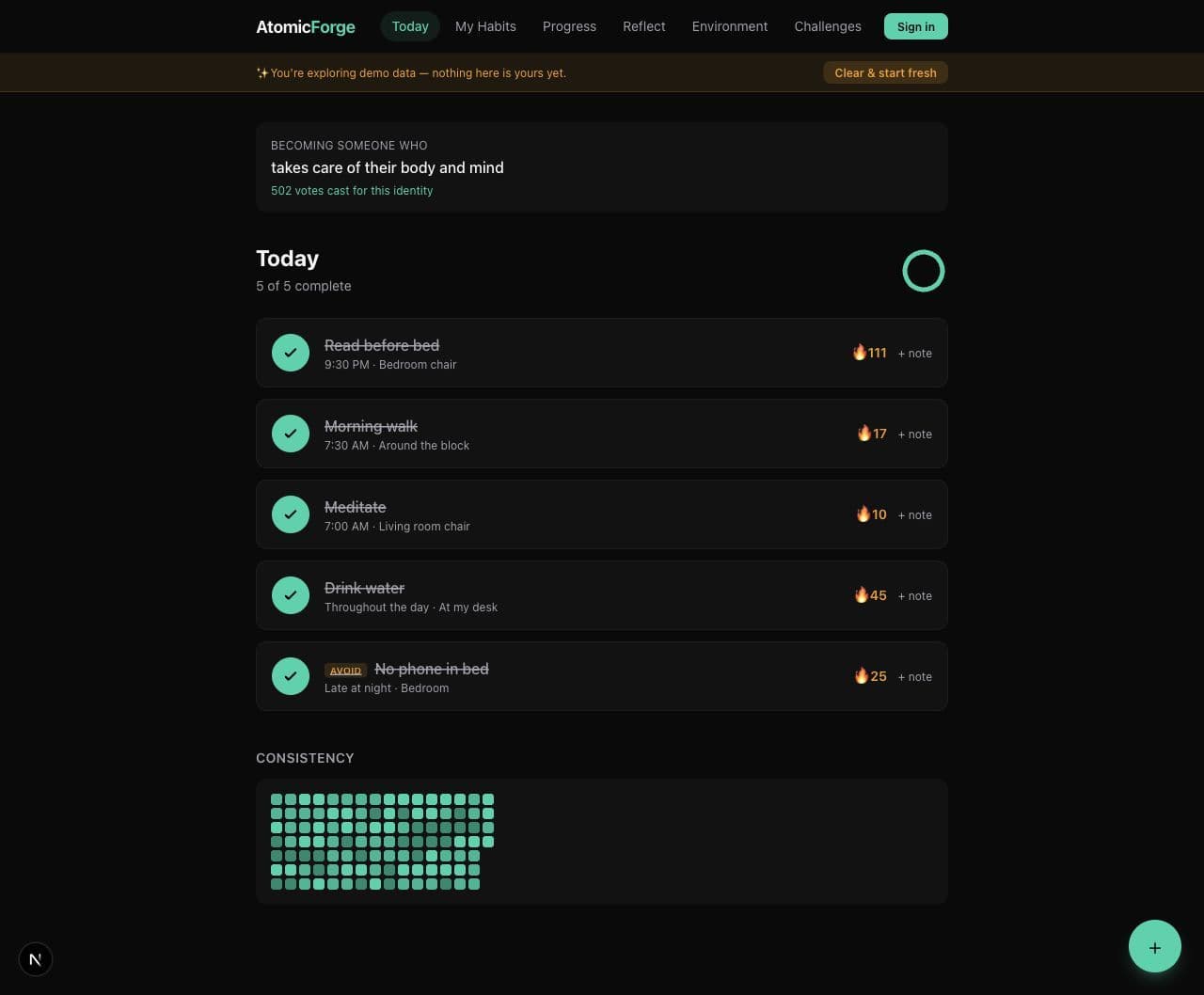
AtomicForge started from one question: what would a habit tracker look like if it actually respected the ideas in James Clear’s Atomic Habits?
Not just the quotes. Not just a streak counter with a prettier checkbox. I wanted the product itself to behave like the book teaches: make good habits obvious, attractive, easy, and satisfying, while making bad habits harder to repeat.
The first idea AtomicForge borrows is identity-based habit building. In the book, the deeper shift is not “I want to read more” or “I want to work out.” It is “I am becoming a reader,” “I am becoming someone who takes care of their body,” or “I am becoming the kind of person who keeps promises to themselves.”
That is why the dashboard does not lead with shame. It leads with votes. Every completion becomes another small piece of evidence for the identity you are building. In the demo account, those tiny actions stack into hundreds of votes. That feels more useful than pretending motivation will arrive on schedule.
The habit wizard is the part most directly shaped by Atomic Habits. A vague goal like “exercise more” is not a habit yet. AtomicForge pushes it through the 4 Laws: what is the cue, what makes it attractive, how can it be reduced to two minutes, and what makes it immediately satisfying?
That is where habit stacking and the Two-Minute Rule show up. “Read more” becomes “After I sit in the bedroom chair at 9:30 PM, I will read one page.” It is smaller, clearer, and much harder for future-you to dodge.
The app also borrows the book’s gentler relationship with streaks. One miss should not erase the whole story. AtomicForge treats one miss as a crack, not a collapse. Two missed scheduled days reset the streak, because “never miss twice” is a better operating rule than “never be human.”
Progress is where the “atomic” part becomes visible. Small habits are boring in the moment because the result is delayed. The progress screen gives that delay a shape: atoms collected, consistency heatmaps, weekday patterns, and the 1 percent better curve.
That curve matters because the book’s argument is not that one perfect day changes your life. It is that repeated small actions compound. AtomicForge tries to make that compounding feel concrete enough that you keep showing up before the dramatic results arrive.
Atomic Habits is also clear that breaking bad habits is not about yelling at yourself. It is about inverting the system. If good habits should be obvious, attractive, easy, and satisfying, bad habits should become invisible, unattractive, difficult, and unsatisfying.
That is why AtomicForge has bad-habit inversion built in. The same design logic works in reverse for patterns like late-night scrolling, skipped walks, or “just checking one thing” on your phone.
Under the hood, AtomicForge is a Next.js app with local-first storage. Firebase sync, AI coaching, and push reminders are optional layers, but the core loop is intentionally simple: design the habit, make the next action tiny, log the vote, and review the pattern.
AtomicForge is not affiliated with Atomic Habits or James Clear. It is a small product experiment inspired by the book’s systems-first approach. The goal is to turn the ideas into a workspace you can actually use on an ordinary Tuesday.
The whole pitch is simple: stop treating habits like personality tests. Treat them like systems. Then make the system small enough to do today.