DevOps
From Zero to Production-Style Kubernetes on AWS with K3s and GitOps
How I built a production-style Kubernetes platform on AWS EC2 using K3s, Terraform, Argo CD, ingress-nginx, cert-manager, Prometheus, Grafana, and Loki, including a real ingress incident and recovery.
🚀 From Zero to Production-Style Kubernetes on AWS with K3s and GitOps
I built this project to simulate how a real platform team operates: declarative infrastructure, GitOps-based delivery, automated HTTPS, full observability, and incident-driven improvement.
This is not a toy cluster — it is a cost-conscious, production-style Kubernetes platform running on AWS EC2 using K3s.
🏗 What I Built
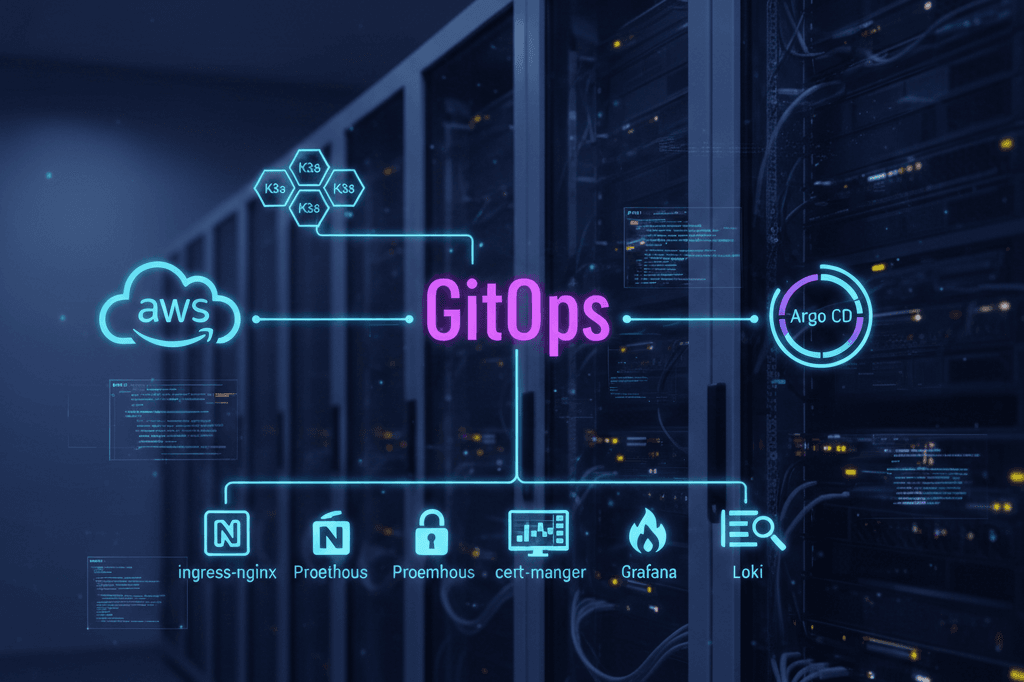
This platform combines:
- Terraform-provisioned AWS EC2 infrastructure
- K3s Kubernetes cluster
- Argo CD (App-of-Apps GitOps model)
- ingress-nginx for HTTP/HTTPS routing
- cert-manager + Let’s Encrypt for automated TLS
- Prometheus + Alertmanager + Grafana for metrics
- Loki + Promtail for centralized logging
The repository is organized by responsibility:
infra/terraform/aws-k3s → Infrastructure provisioning platform/ → Cluster platform services (GitOps managed) apps/ → Application workloads envs/dev → Development environment envs/prod → Production environment
This structure keeps infrastructure, platform, and workloads cleanly separated while supporting multi-environment strategy.
🔁 GitOps Delivery Model
The deployment workflow is deterministic and drift-resistant:
- I push changes to GitHub.
- Argo CD detects configuration drift.
- Argo CD reconciles the desired state into the cluster.
- Manual changes are automatically reverted unless committed to Git.
This enforces Git as the single source of truth and prevents configuration drift.
🌐 Ingress and TLS Automation
I use ingress-nginx to expose services and cert-manager to automate certificate issuance and renewal via Let’s Encrypt.
The result is fully automated HTTPS without manual certificate management.
📊 Observability Stack
Operational visibility is implemented through:
- Prometheus – scraping cluster and workload metrics
- Grafana – dashboards and monitoring visualization
- Loki – centralized log aggregation
- Promtail – log shipping from workloads
This enables metric-based monitoring and log-based troubleshooting from a single interface.
🔥 Real Incident That Improved the Platform
While migrating ingress-nginx to full GitOps management, I experienced a production-style outage.
Symptoms
- TLS certificate mismatch
- Public endpoint unreachable
Root Causes
- K3s default Traefik was still serving traffic.
- ingress-nginx was configured as
NodePort. - After disabling Traefik, host ports 80/443 were not properly owned.
- A manual fix temporarily worked but was reverted by Argo CD because Git still defined the old state.
Durable Fix
- Permanently disable Traefik in K3s configuration.
- Change ingress-nginx service type in Git to
LoadBalancer. - Allow Argo CD to reconcile the corrected desired state.
This incident reinforced the core GitOps principle:
If it is not in Git, it is not a durable fix.
⚖️ Current Trade-offs
To balance realism and cost:
- Single-node cluster (cost-efficient, not HA)
- Some bootstrap steps remain manual (initial K3s + Argo CD installation)
- Environment overlays are evolving
These are deliberate engineering trade-offs, not oversights.
🔭 What’s Next
Planned improvements:
- Add CI validation:
yamllintterraform validate- Kubernetes schema validation
- Fully GitOps-manage cert-manager installation
- Expand environment overlays for workloads
- Add policy enforcement and security hardening
🧠 What This Project Demonstrates
- Infrastructure as Code with Terraform
- Kubernetes cluster operations (K3s)
- GitOps architecture with Argo CD
- Ingress and TLS automation
- Observability integration (metrics + logs)
- Incident debugging and architectural correction
- Production-style operational discipline
🏁 Final Thoughts
This project helped me practice the parts of Kubernetes work that matter most in production:
- Platform design
- Delivery workflows
- Failure modes
- Observability
- Recovery through correct architecture
Building the platform was valuable.
Debugging it under real constraints is what made it production-grade.
Related posts